The Coal River Mountain Wind Campaign
“Coal River Mountain Watch, along with a lot of other very special people, are proposing that the destruction of Coal River Mountain be stopped. We are proposing the water no longer being poisoned and the wildlife and vegetation be left in tact. We are proposing that the Appalachian culture be maintained with access to the mountains for gathering herbs and roots for medicines and food. We are proposing the Coal River Mountain Wind Farm” – Lorelei Scarbro, Rock Creek, WV
How It All Began
In late 2006, David Orr, an environmental politics professor at Oberlin College, and Appalachian Voices , a non-profit conservation organization based out of Boone, NC, wanted to find an economically viable alternative to mountaintop removal coal mining in southern West Virginia that would help to diversify the ‘coalfield’ economy in a sustainable manner. With the knowledge that many of West Virginia’s mountains have great wind potential, they commissioned a national wind consulting firm, WindLogics©, to find a mountain in the coalfields that was still intact and conduct a fine-scale modeling of its wind resource. The mountain they found was Coal River Mountain.
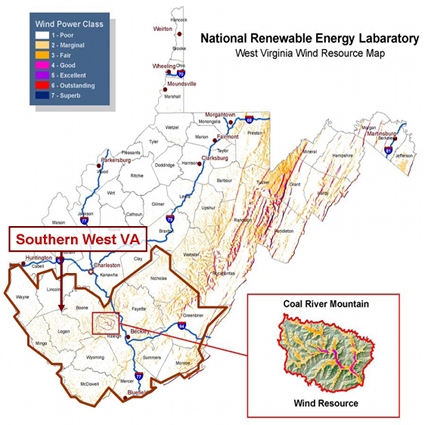
Wind Map of West Virginia with and Coal River Mountain (circled)
[West Virginia Wind map available here, illustration using that map was generated by Downstream Strategies]
The above image shows that the state of West Virginia has excellent wind resources in many areas, including the southern West Virginia coalfields where mountaintop removal coal mining is prominent.
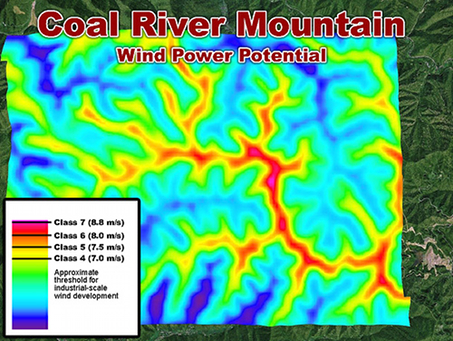
What the WindLogics study showed was that nearly all of the ridges along Coal River Mountain exhibited excellent wind speeds. The wind map created by WindLogics is shown in the image below, and represents the area within the green circle shown in the above image of West Virginia's wind potential. Wind developers are now developing areas that exhibit mid- Class 3 wind speeds, which in the following map is represented by the areas where the green shades are transitioning into the yellow. So, according to these standards, it is obvious that every ridge along Coal River Mountain could be developed for wind power.
WindLogics© map of Coal River Mountain wind resource
[Image created using Coal River Mountain Wind map created by WindLogics©]
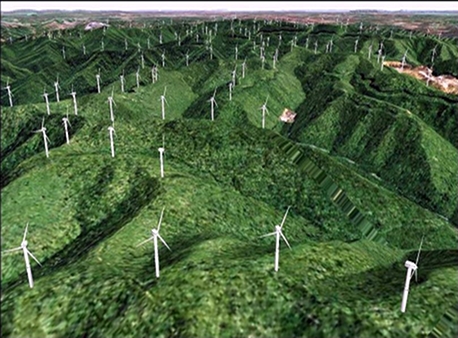
Using the wind map of the mountain, and with technical advice provided by the National Renewable Energy Laboratory and the American Wind Energy Association, a model wind farm was constructed using computer mapping software. The model consisted of two-hundred twenty, two Megawatt (MW) wind turbines, for a total generating capacity of 440 Megawatts of clean, renewable wind energy.
Google Earth image of a model wind farm on Coal River Mountain:
220 turbines, 440 Megawatts
[Image created by Rory McIlmoil using Google Earth Pro, with the assistance of the Coal River Mountain wind map created by WindLogics©]
This model has since been updated by Downstream Strategies (more information below), who showed that a more conservative model wind farm would consist of 164 turbines, for a total generating capacity of 328 Megawatts (MW)[2]
Overall, when the fact that the wind doesn’t always blow is accounted for, a wind farm of this size on Coal River Mountain would generate enough electricity per year to provide West Virginia with approximately 0.9% of its total electricity generation each year[3].
Map of Potential Wind Turbine Locations on Coal River Mountain
Red dots = turbines, gray shading = mining permits
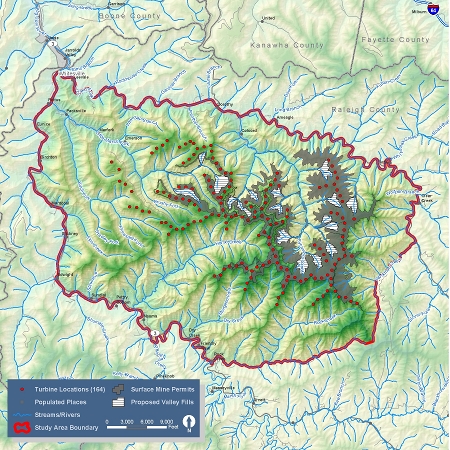
At the time the model wind farm was developed, Massey Energy had already obtained their permit for the Bee Tree surface mine, and had applied for the Eagle II permit. Coal River Mountain Watch (CRMW) and Appalachian Voices took their proposal for the wind farm to the permit hearing for Eagle II held in August of 2008 by the West Virginia Department of Environmental Protection (DEP). The response they received was one of disinterest, and of deference to the mountaintop removal mining permits. No attempt was made on behalf of the DEP to figure out if the option to build a wind farm was the better economic option for the surrounding area, or if a wind farm would result in fewer environmental impacts than the proposed mining.
In response to the DEP’s neglect of the wind option, the Coal River Mountain Wind campaign was initiated by Coal River Mountain Watch in March of 2008 when a group of community members and activists concerned about the future of Coal River Mountain came together in a house in Rock Creek, West Virginia to discuss how to present the idea of a wind farm to local residents and county and state officials. By the end of that meeting, the group had come up with a campaign that would offer exactly what the coal industry and its supporters said they never offered: an economically viable alternative to mountaintop removal coal mining.
The Potential Benefits of Wind on Coal River Mountain
According to an economic study ommissioned by Coal River Mountain Watch from Downstream Strategies, entitled "The Long-term Economic Benefits of Wind vs. Mountaintop Removal Coal on Coal River Mountain, West Virginia," a 328 Megawatt wind farm on Coal River Mountain would:
1) Provide enough energy to power over 70,000 homes (or about 1% of total West VA electricity generation)
Raleigh County alone has about 79,000 total homes, so this one mountain could provide almost enough electricity to power every home in the county with clean, renewable energy. As it stands right now, 98% of the county’s electricity comes from coal.
2) Create 277 local job opportunities during the construction of the wind farm, and an estimated 48 total permanent jobs for local residents related to the operation and maintenance of the turbines.
One issue with coal-related jobs is that they depend on the demand for coal, and upon the operation of the mine. During coal’s bust cycles, thousands of miners can lose their jobs. Also, when the coal in a mine runs out – and over the longer term, when the coal in West Virginia is gone – those mining jobs are lost. By comparison, since electricity will always be in demand, and since the wind doesn’t run out, the jobs related to operating a wind farm will always be available.
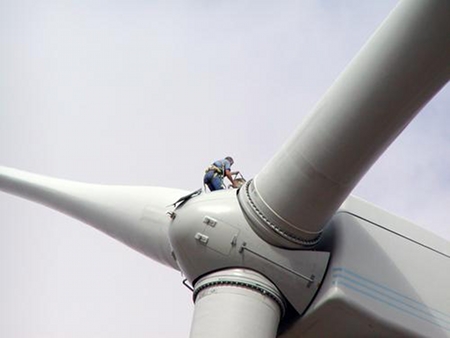
[Image provided by Benji Burrell of Appalachian Voices, with the permission of the National Renewable Energy Laboratory]
3) Contribute $1,740,000 annually in property taxes for Raleigh County and nearly $900,000 annually in Business and Operations (B&O) taxes to the State of West Virginia.
The annual property taxes that a Coal River Mountain wind farm would generate for Raleigh County exceed the total coal severance taxes the county receives each year. For example, in the 12 months leading up to the winter of 2008, Raleigh County had received a total of $1.66 million in coal severance tax receipts – and that was from all coal produced in the county. A wind farm on just one mountain would exceed that amount.
What this shows is that the development of a wind farm on Coal River Mountain, and the development of a local wind industry, could provide Raleigh County with far more tax revenues than coal. This money could be used to further diversify the local economy in a manner that builds upon local knowledge and generates forms of development based on the sustainable use of the land and resources. If this were to happen, the wind farm would help the rural areas of Raleigh County transition away from coal as the coal resources run out.
4) Potentially stimulate the creation of a strong wind industry in southern West Virginia.
There is a lot of wind that can be harnessed for energy production and economic development in southern West Virginia. Some of this could be developed as big, industrial wind farms, but most of it could be developed in the form of small, community-owned wind projects. Counties and the state should take advantage of these wind resources, because if a wind manufacturing plant were sited in Raleigh County, for example, between 2,000 and 3,000 new, permanent, safe jobs could be created.
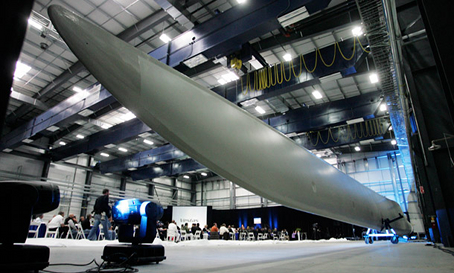
[Photo extracted from here, credit to Associated Press photographer Jack Dempsey]
But this all depends on bringing an end to mountaintop removal on Coal River Mountain and all across southern West Virginia. For without the ridges, there can’t be any wind farms, and without the wind farms, future jobs and revenues are at stake.
Supporting the preservation of the potential benefits of wind, Downstream Strategies – in the economic study they conducted for Coal River Mountain - concluded that:
“state and local leaders should reconsider their singular focus on extraction of coal resources in southern West Virginia and chart a common path forward with local citizens that not only preserves private profits, but also strives—as a central objective—to sustain the local economy over the long term.”[4]
5) Help Reduce West Virginia’s Carbon Footprint, and prevent further contributions to Climate Change.
The construction and operation of a wind farm on Coal River Mountain – by generating clean electricity and reducing the need for burning coal – would result in the direct prevention of over 19.7 million tons of carbon dioxide emissions over the first 20 years of operation. By further stopping the proposed mountaintop removal operations, another 111.5 million tons of CO2 will remain sequestered underground in the form of un-mined coal. In total, the proposed wind farm will prevent over 130 million tons of CO2 from being released to the atmosphere over the first 20 years.
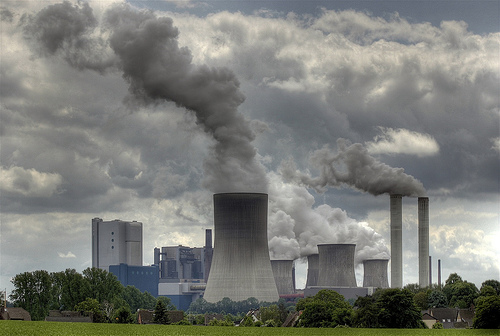
[Photo extracted from here, accessed June 4th, 2009, no photo credit provided]
Looking Toward the Future
A Coal River Mountain wind farm will not stop current underground mining activities from continuing their operations. There are currently five underground mines operating on seams lying underneath Coal River Mountain producing over 3 million tons of coal and employing over 300 miners each year. Due to the depth of these mines, such mining will be able to continue operating to completion in conjunction with a wind farm. The combination of a wind farm and the continuance of underground mining will allow for a transition into a new economy for Raleigh County and the Coal River communities once the coal has been mined out.
The new economy could be an economy based on the sustainable use of the land, the development of alternative sources of energy, jobs and income. The Coal River Mountain wind project, if successful, could serve as a model for economic diversification in other counties and communities, one that calls for the development of renewable energy, the creation of green jobs, and the preservation of the environment for improving the quality of life for both current and future generations.
 Perhaps most importantly, this wind project will save one mountain and the surrounding communities from the decimation and contamination of the land, resources and residents that inevitably result from the blowing up of mountains and the filling of valleys with mining waste. It would exist as a symbol of change and the breaking of the oppressive coal stranglehold on southern West Virginia’s economy and its communities. A wind farm on Coal River Mountain could be the first step toward creating a new and sustainable Appalachia.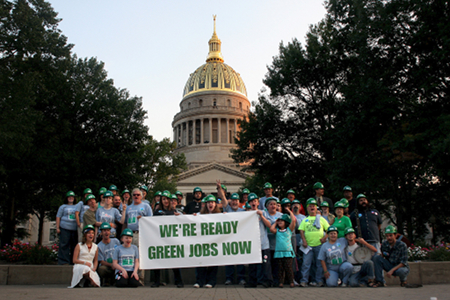
[Photo courtesy of Brett Marshall, ]
For more information on sources used in this theme, please see the Notes on Sources page.
Sylvia_Bradford1-max.mp3Sylvia Bradford clip 1hazy-04-hazy-and-shumates-today
Sylvia_Bradford2-max.mp3Sylvia and Rick Bradford on how MTR has affected their liveshazy-04-hazy-and-shumates-today
Sylvia_Bradford3-max.mp3The Bradfords and trainshazy-04-hazy-and-shumates-today
debbie_jarrell-1-max.mp3Debbie Jarrell on disappearing housing stockhazy-04-hazy-and-shumates-today
Charles-EdClip3.mp3Ed Wiley on the Appalachian Mtns. and waterhazy-04-hazy-and-shumates-today
Sylvia_Bradford5-max.mp3The Bradfords on lack of accesshazy-04-hazy-and-shumates-today
debbie_jarrell-1-max.mp3Debbie Jarrell on Marsh Fork Elementarycoal_river_101-06-changes-in-lifestyle
debbie_jarrell-2-max.mp3Debbie Jarrell on lack of access to the mountainscoal_river_101-06-changes-in-lifestyle
MTR2CharlieBEdit1.mp3Charles Ballard on changes since MTRcoal_river_101-06-changes-in-lifestyle
BettyRoss.mp3Betty Ross on Floodingcoal_river_101-06-changes-in-lifestyle
Meadows1.mp3Jimmy Meadows on outmigrationcoal_river_101-05-outmigration
judy_crm_clip1.mp3Judy Bonds on Coal River Mountaincrm-01-current-land-use-on-coal-river-mountain
Charles-EdClip2.mp3Ed Wiley on Health Effects at MFEhazy-02-marsh-fork-elementary
Thompsonclip1.mp3Ernie Thompson on Slurry Impoundmentsmtr-02-environmental-impacts
Thompsonclip2.mp3Ernie Thompson "Money got in the way"mtr-03-legislation-permits-regulations
Maria1.mp3Maria Lambert on Water Qualityprenter-04-health
Rory-GB4.mp3Gary Anderson on Coal River Windwind-01-introduction-to-coal-river-wind
Rory-GB3.mp3Barbara Anderson discusses Mountain Access and Traditional Usewind-01-introduction-to-coal-river-wind
Rory-Chuck1.mp3Chuch Nelson on Threat of Valley Fills on Coal River Mountainwind-02-the-threat-of-mtr-on-coal-river-mountain
Rory-GB2.mp3Gary Anderson describes 2001 Clear Fork Floodswind-02-the-threat-of-mtr-on-coal-river-mountain
Rory-Chuck4.mp3Chuch Nelson "We gotta shut 'em down"wind-02-the-threat-of-mtr-on-coal-river-mountain
Rory-Judy2.mp3Judy Bonds "The Last Vestige of Jobs and Sustainability"wind-03-the-coal-river-mountain-wind-campaign
Rory-GB5.mp3Gary Anderson Imagines a New Wind Industrywind-04-wind-vs-mtr-for-coal-river-mountain-the
Rory-Chuck3.mp3Chuck Nelson "This is Our Last Chance"wind-06-a-just-transition
MTR2VernonHEdit1B.mp3Vernon Haltom on Protecting Places and Resourcescrm-01-current-land-use-on-coal-river-mountain
EdWileyInEdit1.mp3Ed Wiley "A Magical Place"crm-02-community-land-use-in-coal-river-valley
Meadows1.mp3Jimmy Meadows on Loss of Underground Mining Jobscrm-03-undergound-mining
Charles-EdClip1.mp3Ed Wiley on Sludge Impoundmentshazy-02-marsh-fork-elementary
238002.mp3Laffon Pettry, "Molly mooching"crm-02-community-land-use-in-coal-river-valley
080009.mp3Donna Wills, "nothing I can't can"crm-02-community-land-use-in-coal-river-valley
074025.mp3Randy Halstead, Joys of ginsengincrm-02-community-land-use-in-coal-river-valley
077007.mp3Joe Aliff, harvest timecrm-02-community-land-use-in-coal-river-valley
088006.mp3John Bowman, keeping the mash warmcrm-02-community-land-use-in-coal-river-valley
050002.mp3Benny Turner, Native Americans on Bolt Mtn.coal_river_101-01-history-of-coal-river-part-1
077010.mp3Joe Aliff and his Cherokee grandfathercoal_river_101-01-history-of-coal-river-part-1
119011.mp3Howard Miller, corn-woodland-pastureland systemcoal_river_101-01-history-of-coal-river-part-1
215001.mp3Howard Miller, people hiding on mtn. from marauding soldierscoal_river_101-01-history-of-coal-river-part-1
Joe_Aliff_we_had_a_full_fledged_war_077022.mp3Joe Aliff, arming miners for Battle of Blair Mtn.coal_river_101-02-history-of-coal-river-part-2
046012.mp3Mae Bongalis, a visit with Mother Jonescoal_river_101-02-history-of-coal-river-part-2
141006.mp3Cody Dickens, a visit from the land companycoal_river_101-04-absentee-land-ownership
162008.mp3Dr. Jim Michael Wills of Rock Creek on absentee landownershipcoal_river_101-04-absentee-land-ownership
038002.mp3Shorty Bongalis on West Virginians migrating to Ohiocoal_river_101-05-outmigration
088003.mp3John Flynn about moonshinincoal_river_101-05-outmigration
088004.mp3John Bowman, staying in Coal River by moonshinincoal_river_101-05-outmigration
077024.mp3Joe Aliff, how Coal River Mtn. is a drug storecrm-01-current-land-use-on-coal-river-mountain
Thompsonclip1.mp3Ernie Thompson, former mine inspector on slurry impoundmentscrm-05-the-brushy-fork-slurry-impoundment
Jen-JackSpaderoClips.mp3Jack Spadero, engineer on impacts of MTR and slurrycrm-05-the-brushy-fork-slurry-impoundment
Rory-GB4.mp3Gary Anderson, Coal River Mountain Wind campaignwind-06-a-just-transition
Rory-Judy1.mp3Judy Bonds, coal is NOT West Virginiawind-06-a-just-transition
hazy-01-near-the-mouth-of-hazy1hazy3
coal_river_101-01-history-of-coal-river-part-11coal-river-1011
crm-01-current-land-use-on-coal-river-mountain1crm2
prenter-01-prenter-and-surrounding-communities1prenter4
mtr-01-introduction1mtr6
wind-01-introduction-to-coal-river-wind1wind7
cresources-01-community-resource-mapping1cresources5
hazy-02-marsh-fork-elementary2hazy3
coal_river_101-02-history-of-coal-river-part-22coal-river-1011
crm-02-community-land-use-in-coal-river-valley2crm2
prenter-02-water-quality2prenter4
mtr-02-environmental-impacts2mtr6
wind-02-the-threat-of-mtr-on-coal-river-mountain2wind7
cresources-02-children-are-the-future-of-the-coal-rive2cresources5
hazy-03-absentee-land-ownership3hazy3
coal_river_101-03-glimpse-into-a-coal-river-family-mid-20t3coal-river-1011
crm-03-undergound-mining3crm2
prenter-03-coal-slurry3prenter4
mtr-03-legislation-permits-regulations3mtr6
wind-03-the-coal-river-mountain-wind-campaign3wind7
cresources-03-bill-lucas3cresources5
hazy-04-hazy-and-shumates-today4hazy3
coal_river_101-04-absentee-land-ownership4coal-river-1011
crm-04-forest-resources-and-timbering4crm2
prenter-04-health4prenter4
wind-04-wind-vs-mtr-for-coal-river-mountain-the4wind7
cresources-04-chronicling-the-coal-river-valley-s-coal4cresources5
hazy-05-update-lawsuits-possible-new-location-fo5hazy3
coal_river_101-05-outmigration5coal-river-1011
crm-05-the-brushy-fork-slurry-impoundment5crm2
prenter-05-community-responses5prenter4
wind-05-wind-vs-mtr-for-coal-river-mountain-ener5wind7
cresources-05-clear-fork-couple5cresources5
coal_river_101-06-changes-in-lifestyle6coal-river-1011
crm-06-community-letter-to-w-va-gov-joe-manchin6crm2
prenter-06-stories-from-prenter6prenter4
wind-06-a-just-transition6wind7
cresources-06-connie-and-terry-dillon6cresources5
prenter-07-news7prenter4
wind-07-update-blasting-has-begun-on-coal-river7wind7
cresources-07-danny-cook-and-mack-james-creek7cresources5
wind-08-organizing-for-wind-power8wind7
cresources-08-debbie-jarrell8cresources5
cresources-09-delbert-and-judy-gunnoe9cresources5
cresources-10-elmer-mays-horse-creek10cresources5
cresources-11-frankie-mooney11cresources5
cresources-12-gary-and-barb-anderson12cresources5
cresources-13-jimmy-platt13cresources5
cresources-14-junior-walk14cresources5
cresources-15-justin-wills15cresources5
cresources-16-kathleen-dickens16cresources5
cresources-17-kay-and-danny-howell17cresources5
cresources-18-kendra-dickens18cresources5
cresources-19-lonnie-burnside19cresources5
cresources-20-project-build-it-up-wv-summer-youth-prog20cresources5
cresources-21-project-community-greenhouse21cresources5
cresources-22-project-first-solar-thermal-installation22cresources5
cresources-23-project-greenhouse-gardens23cresources5
cresources-24-project-mural-project-in-whitesville24cresources5
cresources-25-project-the-tadpole-project25cresources5
cresources-26-rachel-bey26cresources5
cresources-27-ray-and-lottie-cottrell27cresources5
cresources-28-sandy-simmons28cresources5
cresources-29-shannon-dickens29cresources5
cresources-30-sharon-thompson30cresources5
cresources-31-sheila-and-natasha-walk31cresources5
cresources-32-sherry-geisler32cresources5
cresources-33-wilma-cook33cresources5
Charles Ballardcoal_river_101-06-changes-in-lifestyle
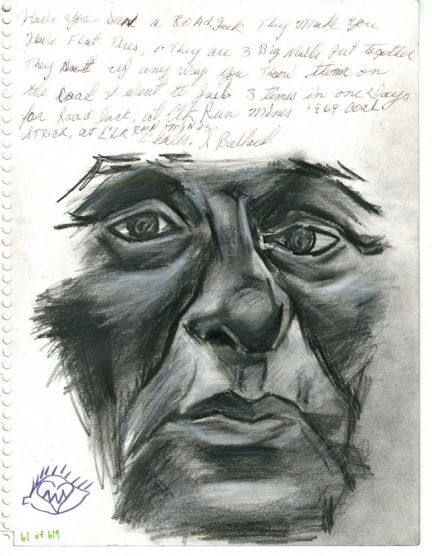
Judy Bondscrm-01-current-land-use-on-coal-river-mountain
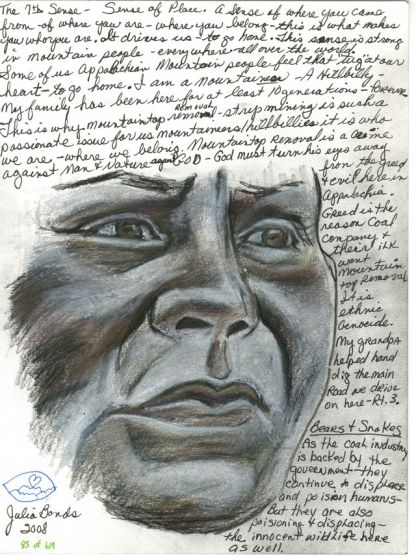
Judy Bonds, 1 of 3coal_river_101-01-history-of-coal-river-part-1
Judy Bonds, 2 of 3coal_river_101-01-history-of-coal-river-part-1
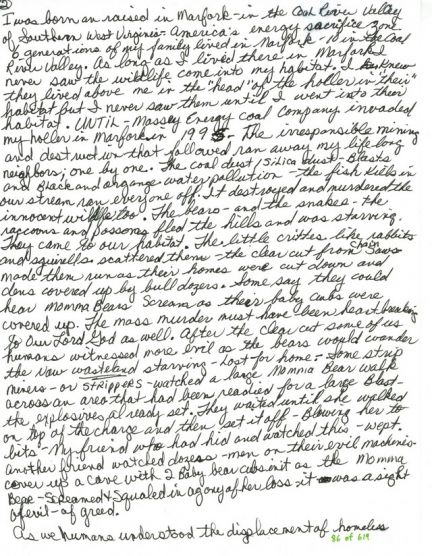
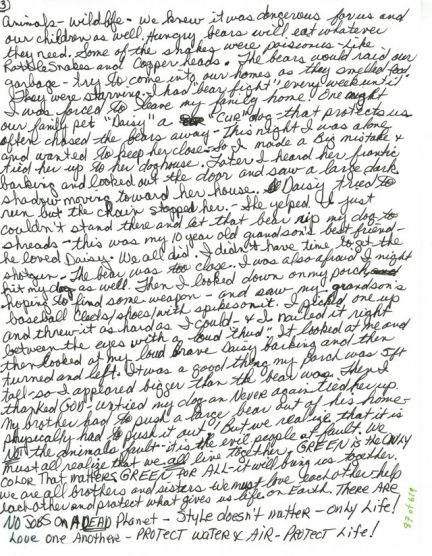
Judy Bonds, 3 of 3coal_river_101-01-history-of-coal-river-part-1
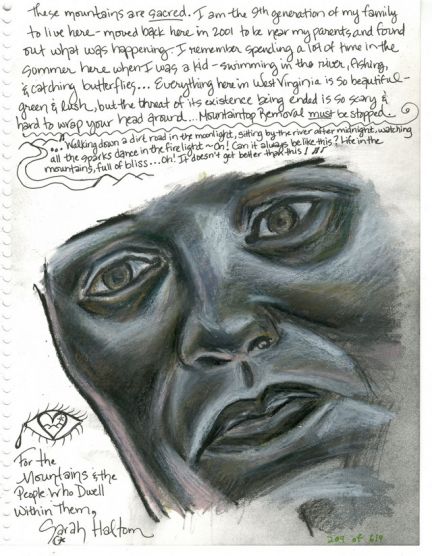
Sarah Haltomcrm-01-current-land-use-on-coal-river-mountain
Vernon Haltomcrm-01-current-land-use-on-coal-river-mountain
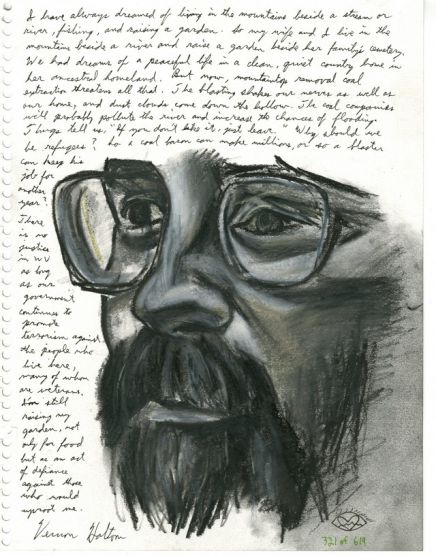
Vernon Haltomhazy-02-marsh-fork-elementary
Debbie Jarrellcoal_river_101-06-changes-in-lifestyle
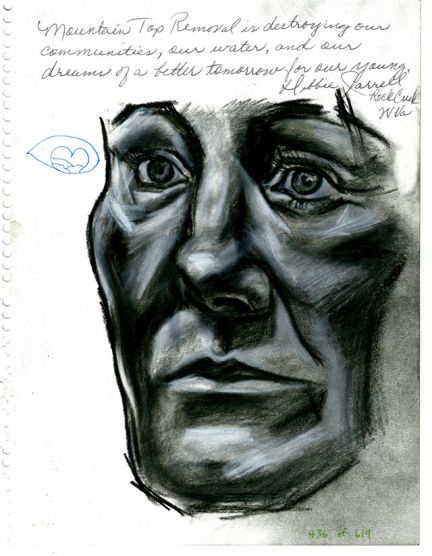
Debbie Jarrellhazy-04-hazy-and-shumates-today
Debbie Jarrellwind-01-introduction-to-coal-river-wind
Debbie Jarrellhazy-02-marsh-fork-elementary
Debbie Jarrellcoal_river_101-05-outmigration
Jen Oshacrm-03-undergound-mining
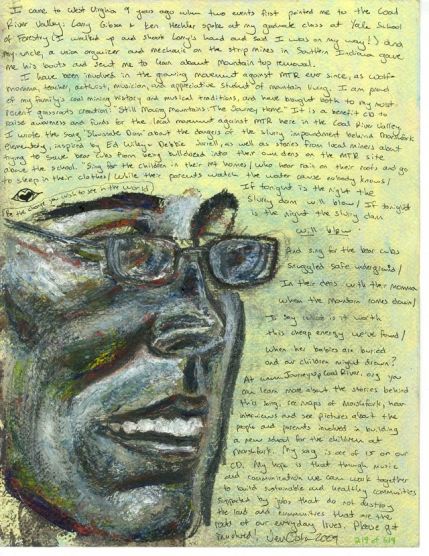
Jen Oshacoal_river_101-06-changes-in-lifestyle
Jen Oshahazy-04-hazy-and-shumates-today
Jen Oshacrm-05-the-brushy-fork-slurry-impoundment
Jen Oshaprenter-07-news
Jen Oshacrm-04-forest-resources-and-timbering
Jen Oshahazy-01-near-the-mouth-of-hazy
Jen Oshahazy-02-marsh-fork-elementary
Ed Wileyhazy-02-marsh-fork-elementary
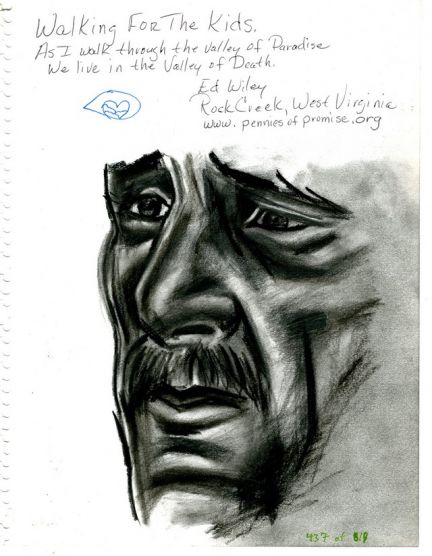
Ed Wileyhazy-04-hazy-and-shumates-today
Ed Wileycrm-02-community-land-use-in-coal-river-valley
Ed Wileycoal_river_101-06-changes-in-lifestyle